
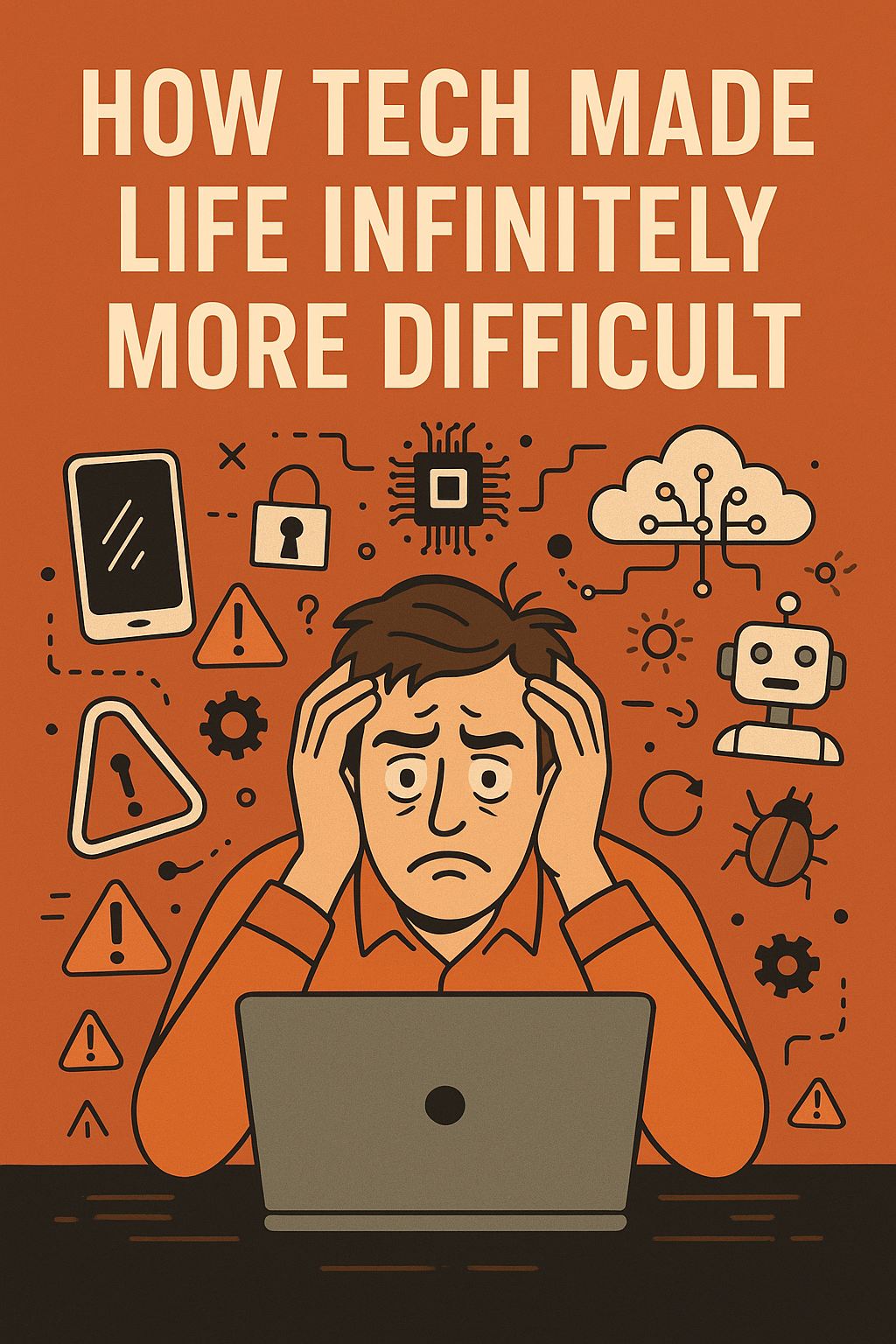
We were told technology would make life easier, smarter, faster, freer. Instead, a lot of us now feel like we have to survive it.
What was once a tool has become a tangle — not just computers and phones, but doorbells, cars, fridges, lightbulbs, thermostats. Then AI showed up, not slowly, but instantly and everywhere at once.
The Promise Was Simplicity. The Reality Is Chaos.
Every update and every new “smart” feature adds friction instead of removing it. Checking your calendar can take three permissions, two app switches, and a captcha. And if something breaks, you get a chatbot, not a fix.
Enter AI
AI was sold as the great simplifier. But AI doesn’t just do things — it changes how things get done. It writes code faster than people can check it, and it rolls out features before anyone fully understands them. Companies race to keep up and ship things that are half-tested and hard to undo.
You wake up and your phone looks different. Your files moved. Your app now has a feature that thinks for you and won’t turn off.
Trust Is the Real Issue
When even the people building AI admit they don’t fully understand how it makes decisions, that’s not a minor bug — that’s a trust problem. Add in deepfakes, scams, and data collection, and the real question isn’t whether you use technology anymore. You live inside it. The question is how you manage it before it manages you.
How to Stay Human in a High-Tech World
Don’t be first. Let the dust settle before you chase the newest version.
Use tools, not toys. If it adds steps instead of removing them, it’s not serving you.
Own what you understand. If a tool takes hours to configure and maintain, it’s not worth it.
Limit AI’s role. It’s a tool, not a boss. Use it with intention — don’t outsource your judgment or your voice.
Value offline. Notebooks, real books, face-to-face conversations — these are survival strategies, not old habits.
Back up everything, twice. Assume nothing is permanent.
Pause before connecting. A simple appliance that always works beats a smart one that crashes.
We Don’t Need More Tech — We Need Better Tech
Technology isn’t the enemy. But it is moving faster than most of us can absorb, and it’s led more by market urgency than by what actually helps people. The answer isn’t to reject it. It’s to demand sanity, protect simplicity, and use the tools that genuinely make life better — and skip the ones that don’t.