
Promises2Kids came to me with a challenge: raise money and hold five hundred people’s attention — in a seven-minute time slot.
Seven minutes. That was the brief.
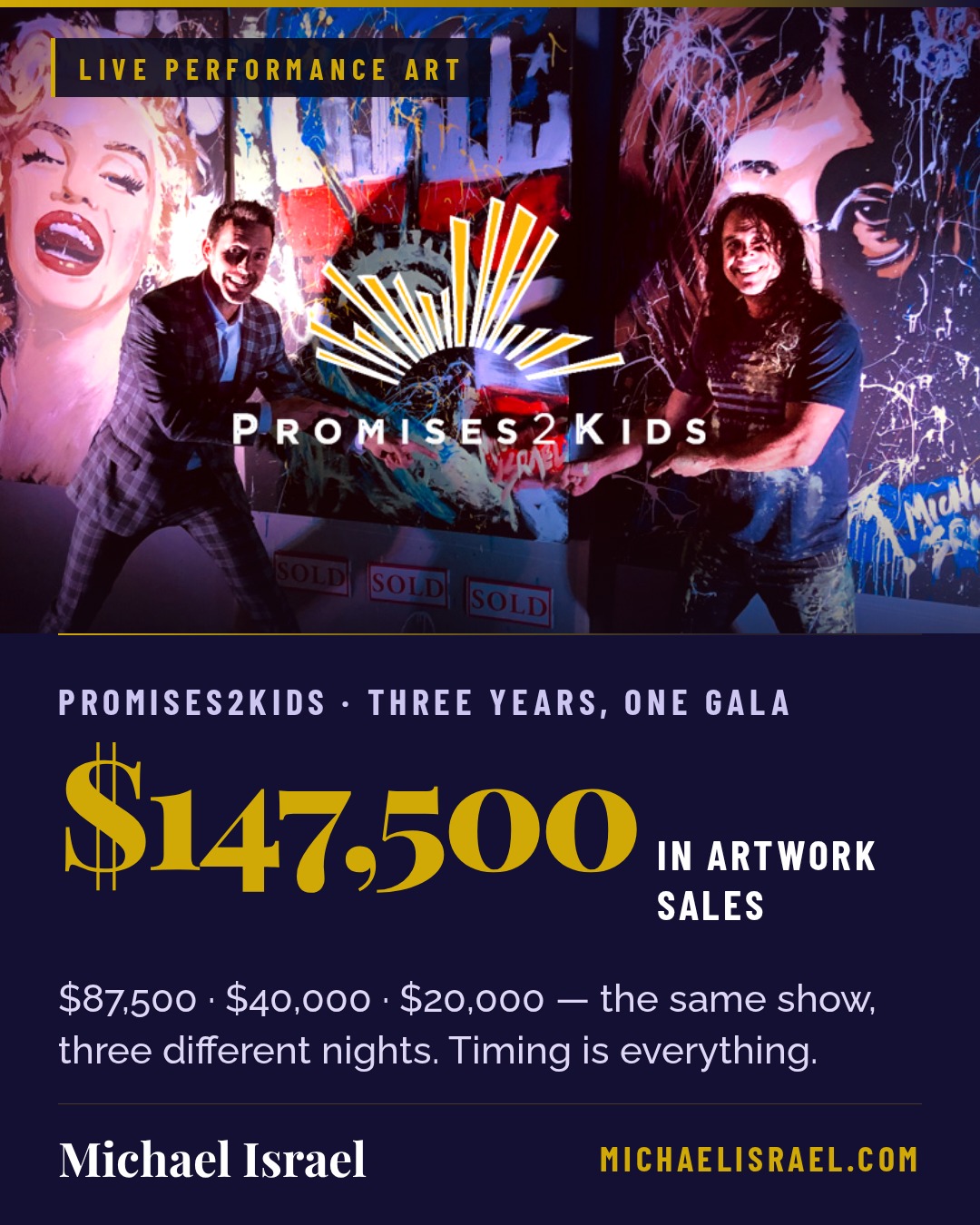
I took it, and I ended up performing that same show for them three years running. A different painting each night, created live. Across those three nights the artwork alone brought in $147,500 in sales for Promises2Kids.
But the total isn’t the interesting part. The interesting part is how it splits.
Night one: $87,500
I painted the Statue of Liberty live, and it landed. The auction had room to breathe, so we ran it the way we always want to — the live piece plus the other works on display, all at once, while the room was still hot.
Several paintings sold that night, not just the one I’d made on stage. And it kept going afterward: two more pieces were commissioned for me to paint back at the studio and ship out. A performance that connects doesn’t only sell the canvas in front of you. It sells the next two.
Eighty-seven thousand five hundred dollars — from seven minutes of painting and an auction that was given the time to do its job.
Night two: $40,000
Belinda Carlisle was performing that year and the venue had a hard sound curfew. The clock won. They cut the auction short to get her on stage before the cutoff.
Paintings still sold. They just sold fast, into a compressed window, and we never got through everything we could have.
Forty thousand. Less than half of night one.
Night three: $20,000
The program ran long. By the time I performed, the evening had already spent itself on everything scheduled ahead of me.
There was no time left. So we sold one painting — the live piece, and nothing else. The rest never made it to the block.
Twenty thousand.
Look at those three numbers again
$87,500. $40,000. $20,000.
Same charity. Same seven-minute show. Same beautiful estate and the same generous crowd. I painted live all three nights and the work was no weaker the third time than the first.
The only thing that changed was time — how much of it the auction got, and whether it arrived while the room still had energy.
That difference is $67,500 less in artwork sales between night one and night three.
Here’s the part most people miss
When an auction gets squeezed, the obvious loss is weaker bidding. That’s real, but it’s the smaller half.
The bigger loss is the paintings that never get sold at all. On a night with time, the live piece pulls the rest of the collection up with it and buyers keep going. On a night without time, you sell one thing and go home. That is the whole gap between $87,500 and $20,000.
What I tell every event coordinator now
Timing is everything at a live event.
If you are running over, cut the things that don’t bring in revenue — or pay for it in lost revenue. Every minute handed to a segment that doesn’t raise money is a minute taken from the segment that does.
Nobody made a mistake on those second and third nights. A sound curfew isn’t a mistake. A program running long isn’t a mistake. But they aren’t free either. They show up in the total the charity collects at the end of the night — and that total is the entire reason everyone came.
I’ve written more on this — the three most common ways a charity auction gets undermined, and how to avoid them.
Why it matters here
Promises2Kids has stood up for foster children in San Diego County since 1981 — kids removed from their homes because of abuse or neglect, through no decision of their own.
The kids Promises2Kids works for will never see my name. They won’t know what got painted, or what it sold for, or that a curfew one year cut the bidding short.
They’ll just know somebody showed up.
That’s enough. But I’d rather show up on a night that’s built to let the money happen.
Promises2Kids has supported foster children in San Diego County since 1981 — emergency shelter, education, mentorship, and support for children removed from their homes. Learn more at promises2kids.org.